History
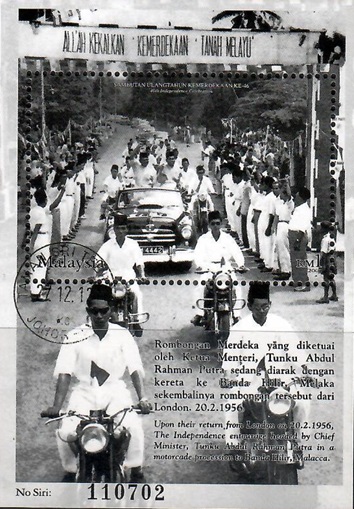
2003 MS showing picture of the welcoming motorcade for Tunku Abdul Rachman after securing the promise of Independence from the UK.
The Malay Pensinsula originally comprised of nine smaller states that later federated to become Malaysia. These states were typically formed around riverine or coastal trading posts. While the oldest such settlements were recorded in Kedah, it is the powerful Sultanate of Melaka (founded 1400 AD) that is considered as the origin of the current Malaysian state. Melaka experienced a century of glory before falling first to the Portuguese and then the Dutch, with the royal family vanishing from the state. Their decendants went on to rule Johor, Perak, Pahang and Trengganu thus providing some continuity. Each of these states existed as independent entities, collections of small chiefdoms with sustanance economies and some trading activity in items for the China trade.
In 1786, one more state came into existence with the cession of Penang and Province Wellesley to the East India Company by the Sultan of Kedah. Penang was intended to become a trading post on the sailing route between India and China but was situated too far northern end of the pirate-infested Straits of Malacca to flourish, which prompted Raffles to establish an alternative entrepot at the southern end of the Straits in Singapore. Penang's glory days were to come a century later when it played a major role in the processing and shipment of export commodities. Perlis was made an independent state after WW2, making for a total of 11 states on the Peninsula.

1957 Independence stamp issue howing rubber tapper, Malaya crest, tin dredge and map of Peninsula.
1957 Independence stamp issue 6c - rubber tapping 24c - tin dredge
Included in the products traded with China was tin that was being mined in Perak. Initially produced on a relatively small scale by artisanal Chinese miners working under the auspices of local Malay chiefs, Western capital entered after the invention of food canning resulted in rising tin demand in the mid 19th C. Along with Western capital came mechnization of the mining process to allow production on a greater scale. In the early 20th C rubber emerged as another key export commodity, demand for which was driven by the car and aviation industries. Initially introduced from Latin America, it drove development of the hinterland, while also leading to large-scale immigration of workers from Ceylon to work on the Estates.
Over the years, as British investment in these industries grew, they sought involvement in the administration of the Peninsula proper, both in an effort to pre-empt other (European) powers and in order to prevent instable conditions from affecting their trade. By this time, the EIC had ceased to exist, and the SS were under direct control of the Colonial Office in London. Initially they made treaties with the individual Malay states, but later drove federation of the States, so as to allow for the development of railways to transport commodities across states to processing facilities and ports.
After WW2, protracted negotiations balancing the demands for primacy from the Malays, and British insistence of full citizenship rights for all communities finally led to the birth of the Malayan Federation in 1957.
After independence, the country built up its manufacturing industry, and economic significance of rubber and tin started declining. Logs, plywood and petroleum exploration contributed to economic development after Sarawak and Sabah joined Malaysia.